API Integration Requirements: Scope, Cost, Acceptance
A buyer brief for scoping custom API work: authorization boundaries, client isolation, acceptance samples, cost drivers and buyer questions.
Workflows, code, accounts and report examples are illustrative. Example numbers and responses are illustrative data, not client results or measurements. Integration scope requires project validation.
Who should commission API integration work?
This article is for business, technical and operations leaders at companies with API integration requirements discovery needs. It is not for readers primarily seeking programming lessons or SEO learning paths. Brands, MCNs, agencies and content service providers often face fragmented processes across multi-platform publishing, account authorization, content status return, data reconciliation and citation monitoring. The purchase is rarely “connect an API”; it is about making business actions, business objects, system boundaries and acceptance samples clear. Choose one verifiable business loop: content from creation and authorization through publishing to status return. That loop exposes account permissions, client isolation, failure handling and reporting definitions. If one loop cannot show value, do not expand to all platforms first. Recommendations in this article, unless marked as supplied reference facts, are proposed designs in original analysis, not delivered capabilities.
Verified platform facts and project implications
The supplied reference summary states that the YouTube Data API uses OAuth 2.0 authorization to access users’ private data, and scopes limit accessible resources. The project implications are threefold. Authorization is not a one-time form: authorization initiation, callback, token storage, invalidation handling and permission scope need to be written into requirements. Scopes should be minimized by business action. Different customers or brands need isolated account boundaries. This fact describes only that platform; it does not prove that other platforms use the same authorization approach, and it does not mean Nara covers any platform. Whether a target platform requires review, how authorization validity and refresh work, and how error codes and revocation are handled need verification against official documentation and integration results. The scope of API integration and custom systems can be reviewed, but the specific support list remains subject to requirements assessment.
Original analysis: solution options and scope
The following are proposed designs in original analysis, not delivered capabilities. Option one: a single-platform narrow loop, suitable for validating authorization, publishing, callbacks and failure retry first. Option two: a multi-platform unified publishing layer, suitable for brands or agencies with many platforms and complex account structures, but it requires unified content objects, a state machine and error classification first. Option three: add search/AI citation monitoring beside the publishing loop as a read-only sidecar that does not block the main flow. A sensible sequence is to use option one, or “single platform plus sidecar monitoring,” to form an acceptance sample, then assess whether to extend to a unified publishing layer.
Scope splitting should list account authorization, client isolation, content mapping, publishing queue, callback/polling, failure retry, manual intervention and reporting reconciliation separately. For acceptance sample design, see Distribution acceptance: queues, limits and callbacks; to compare vendors across platforms, use Choosing a distribution vendor: five criteria to check boundaries.
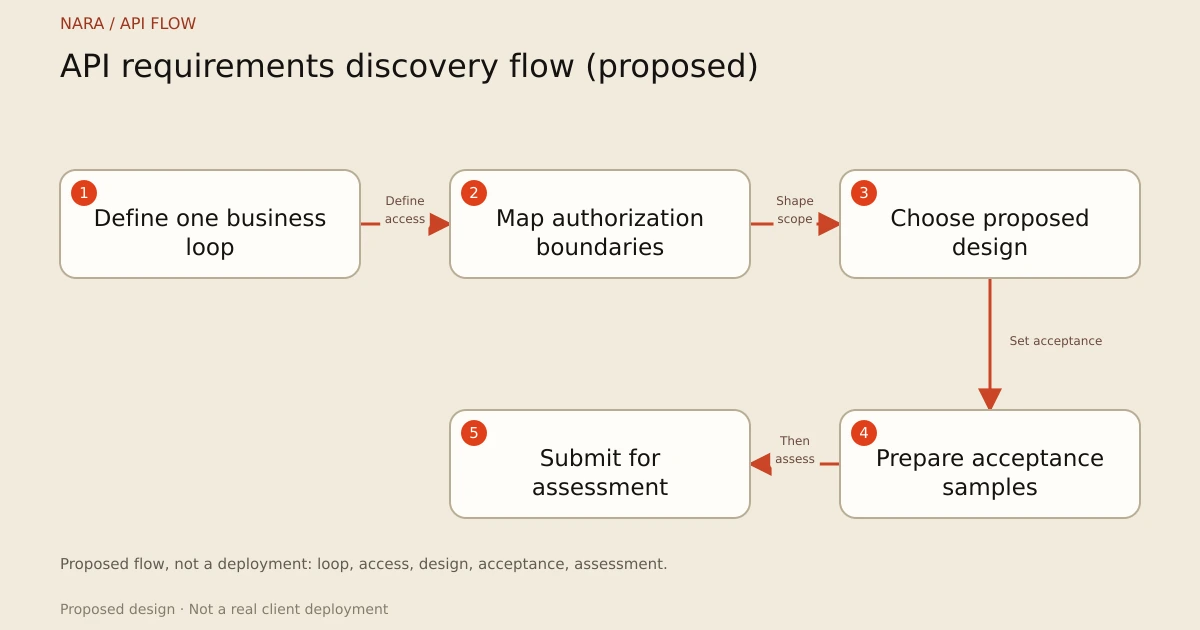
Proposed flow, not a deployment: loop, access, design, acceptance, assessment.
Authorization and permission boundaries
How should account authorization and permission boundaries be agreed? How should authorization expiry, client isolation and responsibility be accepted? Authorization and permission boundaries must be written as acceptance items, not only described in a proposal. A practical split is for the customer to provide platform accounts and business rules, while the service provider implements authorization and calling flows; both sides confirm results against acceptance samples. Specific arrangements follow the confirmed project scope, proposal and delivery arrangements.
Cost drivers usually include the number of target platforms, differences in authorization methods, account volume and hierarchy, content types and field mapping, historical data backfill, synchronization frequency, depth of exception handling, client isolation requirements and acceptance environment preparation. No fixed price or fixed timeline is provided here because these variables need clarification before the service provider can assess them.
Acceptance steps and checklist
Acceptance samples should cover success, failure, retry and permission expiry. The following acceptance steps are recommended in original analysis, not a record of completed tests. Recommended steps: (1) use a test account to complete authorization initiation and callback, and confirm that scopes match business actions; (2) use two customer or brand samples to verify data isolation, confirming that one account’s tokens, content and logs cannot be read by another; (3) simulate authorization revocation or expiry and check whether the system stops calling, marks status and prompts re-authorization; (4) simulate platform errors and timeouts, and verify retry limits, alerts, manual replay and idempotency; (5) check publishing results through callbacks or polling, comparing platform status with local records; (6) spot-check reports and citation monitoring data to confirm that definitions are traceable.
The buyer’s requirements checklist should include at least: target platform list and priorities; account types, volume and ownership; authorization methods and permission scopes; client isolation rules; business objects and fields to synchronize; publishing, update and delete actions; callback/polling and retry strategy; failure alerts and manual intervention; logging and audit requirements; historical data range; acceptance samples and pass criteria; non-functional requirements such as availability, performance and security; and a list of platform capabilities to verify. Do not accept only “the API returned success”; review business status, permission boundaries, failure recoverability and record traceability. If search/AI citation monitoring is included, define collection objects, citation criteria and report format separately, and label them as proposed design rather than delivered results.
Limits, verification needs and contact
The supplied excerpt does not expand on YouTube Data API authorization refresh, revocation, review and error handling details; these points need further verification against official documentation. Other platforms cannot be inferred from this fact. This article does not claim that fact-checking is complete, and it does not promise any platform coverage, processing volume, fixed price, fixed timeline or performance metric. Buyers should put the platform list, account volume, existing systems and acceptance needs into a one-page brief before discussing trade-offs with a service provider.
Submit the platform list, account volume, existing systems and acceptance needs together to support assessment. If you are preparing an API integration development purchase, contact Nara to discuss the platform list, account volume, existing systems and acceptance needs; confirm the project scope first, then move to proposal and delivery arrangements.
Reference source
AI-assisted analysis; platform capabilities are subject to current official descriptions and the confirmed project scope.
Source
AI-assisted analysis. Platform capabilities depend on current official documentation and the confirmed project scope.
Continue assessing your API project
Bring target operations, account ownership, existing software, redacted samples and acceptance requirements to the scope discussion.
Development services · Delivery and acceptance · Cost factors